The Mobile Kitchen Glossary

 Every term you need to plan a temporary kitchen, defined in plain language by the team that builds them.

ADA

ADA refers to the Americans with Disabilities Act, whose accessibility rules can apply to service windows, ramps, and public-facing areas of a kitchen.
Learn more

Amperage

Amperage is the amount of electrical current equipment draws, the figure used to size panels, circuits, and the power source a kitchen needs.
Learn more

Business Interruption Insurance

Coverage that can compensate lost income when operations stop after an insured event. Whether it extends to temporary kitchen costs depends on the policy.
Learn more

Blast Chiller

A blast chiller rapidly cools hot food through the danger zone to safe storage temperatures, protecting food safety and extending shelf life.
Learn more

Building Department

The building department is the local authority that permits and inspects structural, electrical, and mechanical work, part of a kitchen's approval path.
Learn more

Commissary Kitchen

A licensed shared-use commercial kitchen where food businesses prep, cook and store, often the required home base for food trucks and caterers.
Learn more

Commercial-Grade Equipment

Foodservice equipment built for sustained daily commercial loads: NSF-rated, serviceable, and specified identically in mobile and permanent kitchens.
Learn more

Conveyor Dishwasher

A high-throughput dish machine that carries racks through wash and rinse automatically, the warewashing standard for 500+ meals a day.
Learn more

Code Compliance

Meeting the building, health and fire codes of the jurisdiction where a kitchen operates, the make-or-break factor for temporary kitchen deployments.
Learn more

CapEx vs. OpEx

Capital expenditure buys an asset; operating expenditure rents capability. A finite kitchen need is an OpEx problem: rent the kitchen, return it after.
Learn more

Combi Oven

A combi oven combines convection heat and steam in one unit, so a kitchen can roast, steam, bake, and reheat with precise, consistent results.
Learn more

Convection Oven

A convection oven uses a fan to circulate hot air for faster, more even cooking than a standard oven, a workhorse for baking and roasting at volume.
Learn more

Charbroiler

A charbroiler cooks food over direct radiant heat from gas or electric elements, giving meats and vegetables the seared flavor of grilling.
Learn more

Covers

Covers is the foodservice term for the number of guests or meals served, the key figure for sizing a kitchen's equipment and capacity.
Learn more

Catering

Catering is off-premise or high-volume food production, a use case where added or temporary kitchen capacity keeps output high.
Learn more

Concrete Pad

A concrete pad is a level, load-bearing surface prepared on site to support a mobile kitchen and its utility connections.
Learn more

Decanting

Relocating a building's occupants or operations so construction can proceed. In senior living and healthcare, the kitchen is often the hardest space to decant.
Learn more

Dry Storage

Ambient shelving for non-perishables, paper goods and smallwares. A kitchen needs enough of it to avoid daily deliveries.
Learn more

Decks & Ramps

The access structures connecting a trailer kitchen to ground level or adjacent buildings, typically supplied site-side, with ADA needs in mind.
Learn more

Delivery & Installation

The final deployment step (transport, siting, utility connection and commissioning), completed in about one week for a purpose-built mobile kitchen.
Learn more

Demobilization

The removal phase at lease end: disconnecting utilities, preparing the unit for transport and restoring the site, handled with removal assistance.
Learn more

Egress

Egress is the safe, unobstructed path out of a kitchen in an emergency, governed by code for door size, clearances, and exit access.
Learn more

Electrical Panel

The electrical panel distributes incoming power to a kitchen's circuits and breakers, sized to the total load of the equipment it serves.
Learn more

Food Truck

A self-propelled vehicle serving a limited menu to the public, built for mobility and short service windows, not for replacing a full commercial kitchen.
Learn more

Field Kitchen

A kitchen deployed to feed crews where no food service infrastructure exists: construction sites, remote camps, disaster response and military operations.
Learn more

Fire Suppression System

A wet-chemical system in the hood that automatically floods cooking surfaces if a fire starts. Required by fire code in any commercial kitchen, mobile included.
Learn more

Fire Marshal Approval

Sign-off from the local fire authority on suppression, exhaust, gas lines and egress, part of commissioning any commercial kitchen, mobile included.
Learn more

Fryer

A commercial fryer holds heated oil in one or more vats to deep-fry food quickly at volume, a core station for most foodservice menus.
Learn more

Fire Marshal

The fire marshal reviews and inspects fire-safety systems such as hood suppression, gas lines, and egress before a kitchen can operate.
Learn more

Floor Sink

A floor sink or floor drain is a recessed drain that receives wastewater from equipment and cleaning, keeping the kitchen floor dry and sanitary.
Learn more

Foundation

A foundation is the prepared, load-bearing ground a kitchen sits on, from a simple pad to engineered footings, depending on site and duration.
Learn more

Ghost Kitchen

A delivery-only commercial kitchen with no dine-in space, producing food exclusively for online and app-based orders.
Learn more

Grease Trap

A device that intercepts fats, oils and grease before wastewater reaches the sewer, required by most jurisdictions for commercial kitchen discharge.
Learn more

Generator Power

On-site electrical generation sized to carry a commercial kitchen's load where grid power is unavailable or insufficient.
Learn more

Greywater Disposal

Handling the wastewater a kitchen produces, via sewer connection or holding tanks and pump-outs, always through a grease trap where required.
Learn more

Griddle

A griddle, or flat top, is a flat heated steel surface for cooking eggs, pancakes, burgers, and more across a large, continuous cooking area.
Learn more

Grease Interceptor

A grease interceptor captures fats, oils, and grease from kitchen wastewater before it reaches the sewer, a common code requirement for foodservice.
Learn more

Health Permit

The license a local health department issues to operate a food service facility, required for a mobile kitchen just as for a permanent one.
Learn more

Health Department Inspection

The on-site review a health inspector performs before and during operation, checking food safety, sinks, refrigeration and sanitation.
Learn more

HACCP

Hazard Analysis and Critical Control Points, the food-safety framework that identifies where hazards can occur and sets monitored controls at each point.
Learn more

Hand Sink

A hand sink is a dedicated handwashing basin required at key points in a commercial kitchen to support hygiene and pass health inspections.
Learn more

Health Department

The health department is the local authority that permits and inspects foodservice operations for sanitation and food-safety compliance.
Learn more

Ice Machine

A commercial ice machine produces and stores ice for drinks, food display, and cold holding, sized to a kitchen's daily demand.
Learn more

Kitchen Continuity

Keeping food service running at full standard while the permanent kitchen is offline for a renovation, expansion or emergency.
Learn more

Kitchen Rental Lease Term

The contracted duration of a mobile kitchen rental, from a 1-month minimum to multi-year deployments, aligned to the project window.
Learn more

Lead Time

The time from first contact to a serving kitchen: discovery, design, permitting and delivery, typically a few weeks to a few months end to end.
Learn more

Mobile Kitchen

A fully equipped commercial kitchen built into a transportable unit, ready to cook at full capacity wherever a permanent kitchen is unavailable or doesn't exist.
Learn more

Mobile Kitchen Trailer

A commercial kitchen built into a road-towable trailer, connected to site utilities and rented for months to years of daily food service.
Learn more

Meals-Per-Day Capacity

The number of full meals a kitchen can produce daily: the primary sizing metric for a mobile kitchen, from 150 to 650+ meals per day.
Learn more

Makeup Air Unit (MAU)

Equipment that replaces the air exhausted by kitchen hoods with conditioned outside air, keeping the kitchen balanced, cool and code-compliant.
Learn more

MEP (Mechanical, Electrical, Plumbing)

The three building systems (HVAC, power, water and waste) that make a space operable. In a purpose-built mobile kitchen they arrive pre-installed.
Learn more

Mop Sink

A mop sink is a low floor-mounted basin for filling and emptying cleaning water, keeping sanitation water separate from food-prep sinks.
Learn more

NSF Certification

The sanitation standard for foodservice equipment (NSF/ANSI). Health inspectors expect NSF-listed surfaces and equipment in any commercial kitchen.
Learn more

Natural Gas

Natural gas is a piped utility fuel for cooking equipment, connected from the municipal main to a kitchen's pre-installed gas line.
Learn more

Off-Grid Operation

Running a mobile kitchen without mains services, drawing from water tanks and generators. This is what makes remote camps and greenfield sites feedable.
Learn more

Purpose-Built Mobile Kitchen

A mobile kitchen designed and manufactured from the ground up as a commercial kitchen, built to the same standard as a permanent facility.
Learn more

Provisioning

Creating food service where no kitchen exists: feeding crews on construction projects, data center builds, mining and workforce camps for the project's duration.
Learn more

Prep Station

A dedicated zone with worktops and refrigerated rails where ingredients are prepped ahead of service, separated from the cook line in a functional layout.
Learn more

Potable Water Tank

A food-safe water reservoir supplying a kitchen where no mains water exists, sized against daily production, warewashing and cleaning volumes.
Learn more

Plan Review

Plan review is the stage where local health and building authorities examine kitchen drawings and specs before approving a permit to build or operate.
Learn more

Propane

Propane is a portable bottled gas that fuels kitchen equipment where natural-gas mains are unavailable, common on remote and off-grid sites.
Learn more

Potable Water

Potable water is water safe for drinking and food prep, supplied to a kitchen from a municipal main or, off-grid, from a dedicated tank.
Learn more

Retrofitted Trailer

A cargo or event trailer converted into a makeshift kitchen after the fact: the cheap fallback that breaks down under months of daily commercial use.
Learn more

Renovation Downtime

The window during a kitchen renovation when the permanent facility can't produce, typically several months that service must be covered another way.
Learn more

Reach-In Refrigeration

Upright or undercounter refrigerated cabinets positioned at the cook line for immediate-use ingredients, complementing walk-in storage.
Learn more

Support Units

Trailers deployed alongside a mobile kitchen (laundry, restroom and shower units) that complete site services on extended deployments.
Learn more

Service Disruption

Any event that takes a commercial kitchen out of service (fire, flood, equipment failure or planned construction), forcing a continuity decision.
Learn more

Swing Space

Temporary space that absorbs a facility's operations during construction. For kitchens, a mobile kitchen trailer is the swing space.
Learn more

Seasonal Surge

A predictable peak in covers that exceeds the permanent kitchen's capacity. Resorts, clubs and venues bridge it with temporary kitchen capacity.
Learn more

Steel-Frame Construction

Structural steel framing used in purpose-built mobile kitchens, making them weather-resistant and durable under heavy-duty long-term use.
Learn more

Site Prep

The groundwork before a mobile kitchen arrives: a level pad, utility access and clearances. Purpose-built units are engineered to keep it minimal.
Learn more

Salamander

A salamander is an overhead broiler used to finish dishes, melt, brown, and toast, mounted above the range to save counter space.
Learn more

Sandwich Prep Table

A sandwich prep table is a refrigerated counter with pans of chilled ingredients on top and cold storage below, built for fast made-to-order assembly.
Learn more

Single-phase Power

Single-phase power is the standard lighter-duty electrical supply, suitable for smaller kitchens but often insufficient for heavy commercial equipment.
Learn more

Sewer

Sewer is the municipal wastewater connection that carries a kitchen's drain water away, one of the utility hookups a site must provide.
Learn more

Septic System

A septic system treats and disposes of wastewater on site where no municipal sewer exists, a common consideration for remote kitchen deployments.
Learn more

Temporary Kitchen

Any interim commercial kitchen used while a permanent one is offline or not yet built, a need that typically runs from a few months to a few years.
Learn more

Turnkey Kitchen

A kitchen delivered ready to operate: equipment, HVAC, fire suppression, refrigeration and utility connections pre-installed before it arrives on site.
Learn more

Type 1 Hood

An exhaust hood required over grease-producing equipment, with grease filters and fire suppression. Mandatory for ranges, fryers and grills, trailers included.
Learn more

Three-Compartment Sink

The wash-rinse-sanitize sink health codes require for manual warewashing in commercial kitchens, standard in every mobile kitchen configuration.
Learn more

Third-Party Inspection

Independent verification that a manufactured unit meets applicable codes before it ships. It de-risks local approvals for modular and mobile kitchens.
Learn more

Tilt Skillet

A tilt skillet is a large floor-mounted braising pan that sautes, simmers, braises, and holds food in volume, then tilts to pour out the contents.
Learn more

Three-phase Power

Three-phase power is a commercial electrical supply that runs heavy kitchen equipment efficiently, common in foodservice but rare in homes.
Learn more

Utility Hookups

The standardized water, power, gas and waste connections a mobile kitchen uses on site. The unit arrives pre-plumbed and pre-wired; the client provides the sources.
Learn more

Workforce Camp

Temporary housing for crews on remote projects (mining, energy, large construction) where feeding workers on site is a core logistical requirement.
Learn more

Walk-In Cooler

A room-sized refrigerated storage space holding 35–41°F, the backbone of cold storage for any kitchen producing hundreds of meals a day.
Learn more

Walk-In Freezer

A room-sized frozen storage space held at or below 0°F, giving a kitchen the frozen inventory depth needed for multi-week menu cycles.
Learn more

Worktop

A worktop is the stainless prep surface where food is portioned, assembled, and plated, the backbone of an efficient back-of-house layout.
Learn more
Thank you! Your submission has been received!
Oops! Something went wrong while submitting the form.

Tell us about your kitchen needs and request a quote.

Simple green triangle pointing to the right on a white background.

Turnkey mobile kitchen

Simple green triangle pointing to the right on a white background.

Proudly made in-house in the USA

Simple green triangle pointing to the right on a white background.

Commercial grade kitchen equipment

Simple green triangle pointing to the right on a white background.

Code-compliant

Trusted by Industry Leaders

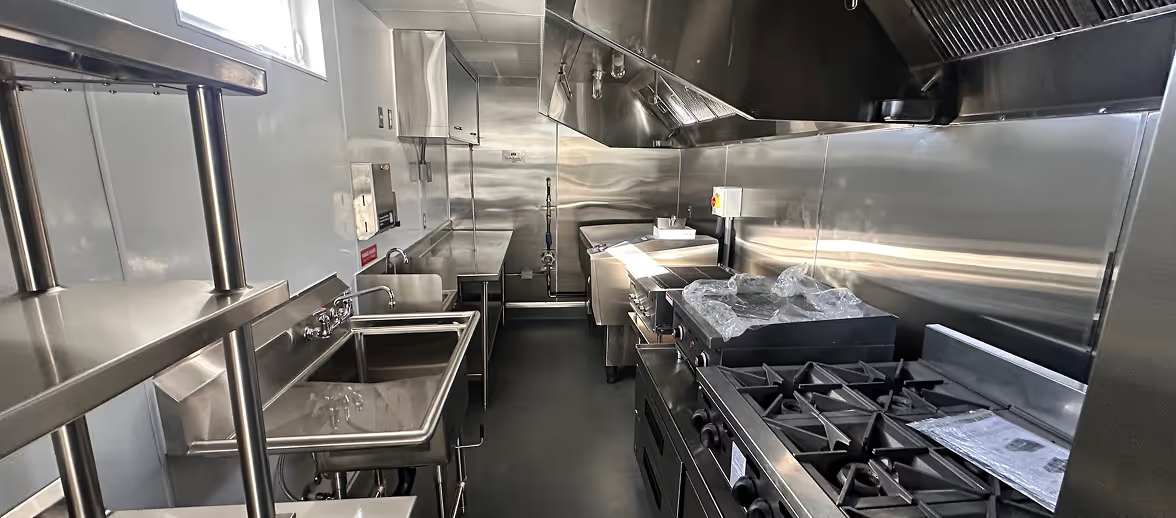
Modern commercial kitchen with stainless steel appliances, multiple sinks, and cooking equipment.