.gif)
%20(1)%20(1).avif)
In March 2024 a fallen tree hit a power panel at Rivermont Golf Club in Johns Creek, Georgia. The fire started in the laundry room. By the time it was out, Appen Media reported, roughly 90% of the clubhouse was affected, the roof above the kitchen had collapsed, and the building would be closed for several months. The general manager told the paper he hoped it would "come back online in sections or phases."
The course stayed open. The kitchen did not. That is the shape of it for a club GM: the fire need not start in your kitchen for the kitchen to be what stops you, and the golf carries on while the dining room goes dark.
Cooking remains the largest single cause: the U.S. Fire Administration puts it at 30% of all nonresidential building fires, counting 33,300 in 2023 and $50.3 million in loss, up 13% across the decade. What follows is what a mobile kitchen does for a club in that position — and, the part most coverage skips, how long it really takes.
%2520(1).avif)
Understanding the Fire Recovery Challenge for Country Clubs
When a club kitchen goes down, three clocks start at once and only one is the builder's: the insurance clock, the permitting clock, and the member clock. The member clock is the shortest. Dues are billed monthly whether the dining room serves or not, and a season of "the grill's closed, sorry" is the version members remember.
Reconstruction is rarely quick. Fire damage usually means rebuilding rather than repairing, which pulls in current code rather than the code the room was built to — NFPA 96 ventilation and suppression compliance gets verified from scratch, and that adds time nobody allowed for. Our renovate-or-rebuild comparison covers how that decision usually goes.
The difference from a planned renovation is not the work. It is that you have no lead time. A club renovation is scheduled around the quiet months. A fire picks its own date.
%2520(1).avif)
Commercial Mobile Kitchen Capabilities for Emergency Response
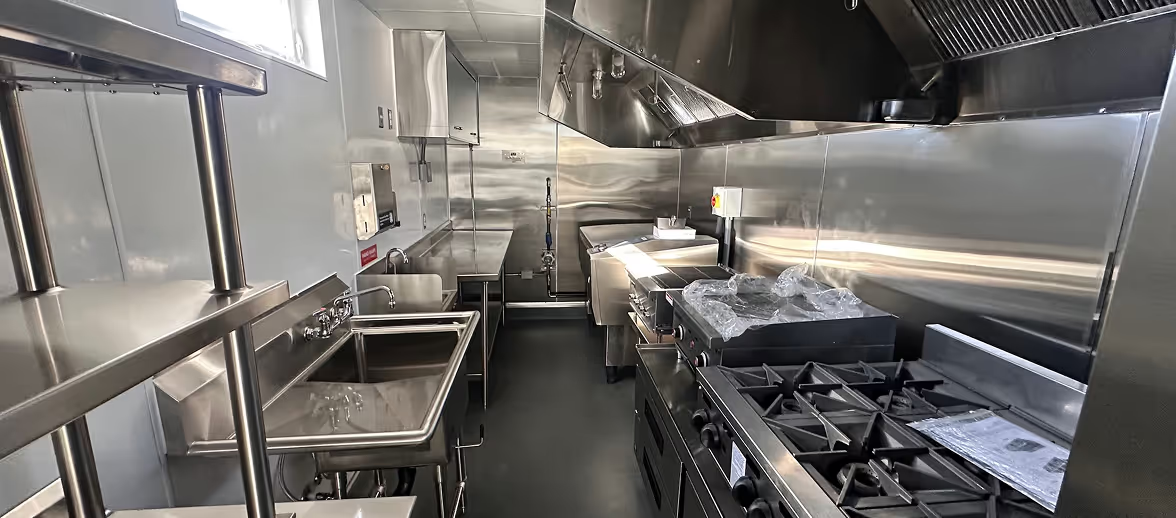
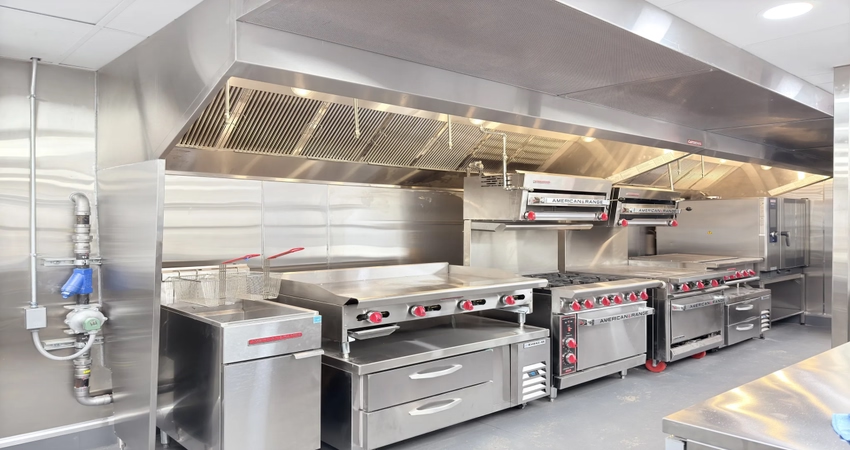
A purpose-built mobile kitchen is a full commercial line in a towable envelope: hot cooking, walk-in and reach-in refrigeration, prep, warewashing and dry storage, built to the code your inspector applied to the room that burned. Not a converted box with equipment bolted in afterwards — what separates the two over a multi-month deployment is covered in our comparison of the builds.
Ventilation, suppression and NSF-certified equipment meet the same requirements as a permanent installation. For a club that has just had a fire, that matters more than usual: your authority having jurisdiction will be paying closer attention than normal, not less.
Production Capacity and Equipment Standards
Mobile kitchens support 150–650 meals per service period depending on footprint. Equipment includes:
- Full hot cooking lines, gas or electric
- Walk-in and reach-in refrigeration with monitored temperature control
- Commercial warewashing with sanitizing cycles
- Prep stations with integrated sinks and work surfaces
- Dry goods and cleaning storage
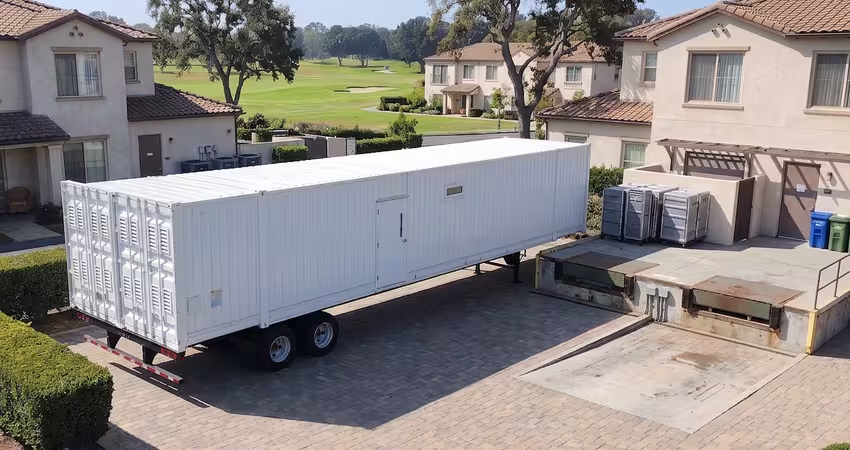
Example: A 53′ unit produces 300–450 covers per service, which covers most clubs' daily dining and a mid-sized member event. A 2×53′ configuration takes that to 500–650.
Health Department Compliance and Safety Protocols
The same health code applies. FDA emergency food safety guidance holds temperature control, sanitation and staff hygiene to the standard you were already meeting — an emergency does not lower it.
Deployment requires health department inspection and permits exactly as a permanent kitchen does, and the permit is the club's, not the supplier's. Our code and permit guide sets out who asks for what.
Strategic Deployment During Fire Recovery Phases
The First Two Weeks: What You Can Actually Move
Be clear-eyed about the timeline, because most of what is written about fire recovery is not. Ours runs six to fifteen weeks end to end, and only the last stage is genuinely quick:
| Stage | Duration | Who controls it |
|---|---|---|
| Agree scope | 2–4 weeks | Shared — compressible if you have pre-qualified a supplier |
| Design | 2–4 weeks | Us, running alongside the builder's damage assessment |
| Permitting | 1–6 weeks | Your jurisdiction |
| Delivery and installation | ~1 week | Us |
| Total | 6–15 weeks | Shared |
That third column is the honest answer to "why can't you just be here Thursday." Permitting is the stage that stretches, and it is the one nobody in this table can hurry.
So nothing done in the first 72 hours makes a kitchen appear. What those first two weeks can do is take weeks off the back end. Open the insurance claim. Get the damage assessment booked. Start scoping with a supplier before the full extent of the damage is known, since scope and design run alongside the builder's assessment rather than behind it. Survey what power, water and waste the site could actually offer — our electrical planning guide covers what to measure. And open the permit conversation with the health department and fire marshal that same week, not once a unit is on order.
Tip: Clubs that have pre-qualified a supplier before anything goes wrong compress the front half of that timeline, because scoping is already done. Clubs starting from a cold search after a fire do not.
Medium-Term Operations: Months 1–12
Extended deployments are where menu engineering earns its keep, and most chefs find a shorter card runs cleaner than the one they were carrying before.
Storage gets underestimated. Refrigeration and dry storage units can be added alongside the kitchen rather than asking one trailer to do everything — and lease terms matter here, because reconstruction dates move and a lease that cannot move with them becomes its own problem.
Event and Tournament Support
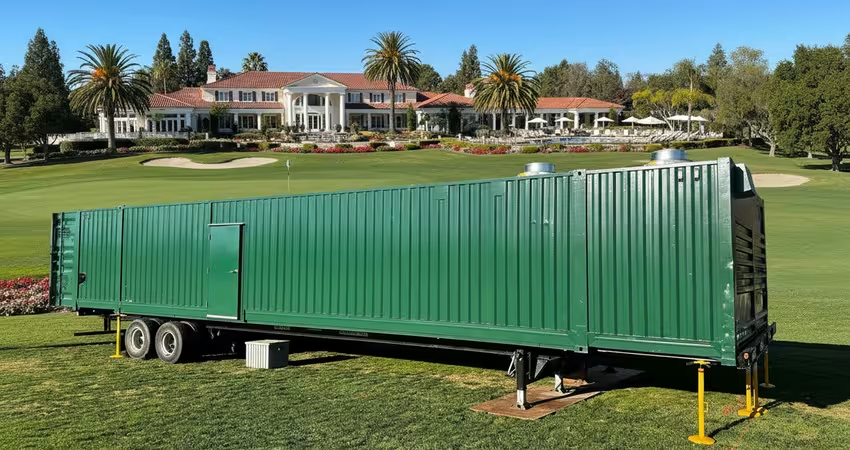
Positioning is the advantage: a unit can sit by the clubhouse, the event lawn or the course, so food travels no further than before. For member events already on the books, that is the difference between honouring them and refunding them. Larger ones can run two units — volume in one, cold prep and plating in the other.
This is continuity for a club's own calendar across a multi-month deployment. A mobile kitchen is not a same-week answer for a single booking, and the minimum lease is one month.
%2520(1).avif)
Financial Considerations and Insurance Coverage
Insurance is the first call and the one to be careful about. Whether business-interruption or extra-expense coverage will pay for a temporary kitchen depends entirely on your policy wording, your carrier and your adjuster — it is not something a supplier can tell you, and anyone who promises it is guessing at your policy. Ask your broker in the first week what your policy actually says about extra expense and temporary facilities, and get the answer in writing before you commit to anything. Our rental insurance guide covers the coverage the rental itself requires, which is a separate question.
SBA physical disaster loan programs are worth checking in parallel, particularly where a declared disaster is involved.
Cost-Benefit Analysis of Operational Continuity
The comparison that matters is not rental cost against zero. It is rental cost against what a dark dining room does over the same months: resignations at renewal, member events that move to a club that can host them, kitchen staff who take permanent jobs rather than wait out a rebuild, vendor relationships that lapse when the orders stop. Our downtime cost breakdown works those through, and the ROI calculation runs them against your own numbers.
For a GM there is a second column no spreadsheet carries: what you can tell the board. "Closed until the rebuild finishes" and "serving from a temporary kitchen from month three" are different meetings.
Reconstruction Planning and Kitchen Design Decisions
A fire usually forces a rebuild rather than a repair, and a rebuild is a chance to fix what the old room got wrong. Months on a temporary line tell you things a drawing cannot — which stations were the real bottlenecks, what equipment the team reached for, where the workflow doubled back.
Tip: Have the chef keep a running note through the deployment. It is the best design brief the permanent kitchen will ever get, and it expires the moment everyone is busy again.
Transition Back to Permanent Operations
Most clubs do not switch over in a day. Running both kitchens briefly lets the new room be commissioned under real service without the whole operation depending on it, and gives staff time on unfamiliar equipment before it is the only equipment. Our renovation timeline covers how that overlap is usually sequenced.
Emergency Preparedness and Risk Mitigation
This is where the six-to-fifteen weeks gets decided, and it gets decided beforehand. A club that has already scoped a unit, surveyed its utilities and identified where a kitchen could stand has taken the slowest part out of its own crisis. A club starting cold does all of that while also handling the insurer, the fire marshal and the membership.
Mobile Culinaire designs, engineers and manufactures its units in-house in Oregon, with more than 400 delivered, as an approved modular manufacturer in multiple states. At Menlo Circus Club in California, a joined pair of 53-foot units carried the club's full card for five months at 400 to 500 covers a day, inspected to California code and plumbed to a grease trap. That was a scheduled renovation, not a fire — worth saying plainly. It proves a club can run its real menu from a temporary kitchen for months. It does not prove a unit arrives overnight.
Note: Pre-qualifying a supplier costs nothing and commits you to nothing.
Disclaimer
Codes and permitting vary locally, and your authority's adopted edition governs. Check health, fire and building requirements with them before fixing dates; the permit is the club's. None of this is insurance advice — coverage is a question for your broker.
People Also Ask
How quickly can a mobile kitchen be deployed after a fire?
Plan on six to fifteen weeks. Roughly half is scope and design, permitting adds one to six depending on your jurisdiction, and the unit itself goes in over about a week. Pre-qualifying a supplier compresses the front half; nothing compresses the permit. Our delivery and setup process covers that final week.
What kitchen capabilities can be maintained during fire recovery?
Full hot line, refrigeration, prep, warewashing and storage — enough to run a club's normal menu rather than a reduced one. Capacity runs 150–650 meals per service by footprint. What is inside a unit sets out the specification in detail.
How long can a club operate from a mobile kitchen?
Months to a few years. The minimum lease is one month and clubs routinely run a unit through an entire rebuild. Build lease flexibility in from the start, because reconstruction dates move.
Will insurance pay for it?
That depends on your policy, your carrier and your adjuster, and no supplier can answer it for you. Ask your broker in the first week what your policy says about extra expense and temporary facilities, and get it in writing.
Conclusion
The clubs that recover well from a fire are rarely the ones that moved fastest afterwards. They are the ones that had already answered the slow questions — who the supplier is, what the site can carry, which authority signs off — so the only clock left running was the builder's.
If your clubhouse is twenty years old and you have never had that conversation, have it now, while nothing is on fire. It costs nothing and it is the only part of this timeline you control.

Testimonial
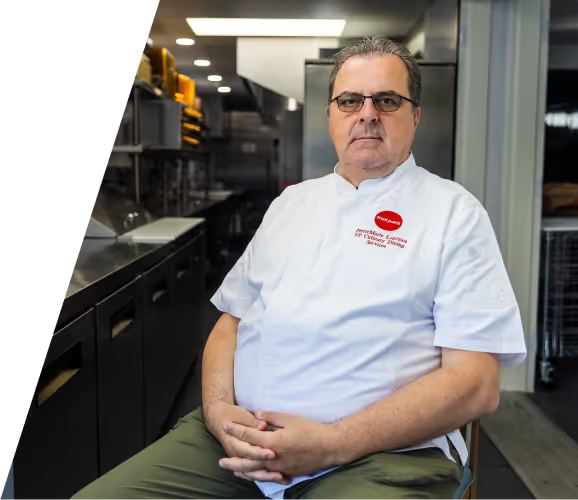
"What is standing out when you look at the mobile kitchen operation is the efficiency that we can really achieve because it's built for that."
Tell us about your kitchen needs and request a quote.
.png)
Turnkey mobile kitchen
Proudly made in-house in the USA
Commercial grade kitchen equipment
Code-compliant
Trusted by Industry Leaders