.gif)
%20(1).avif)
Lost covers are the cost everyone budgets for. They are also the easiest to model and the fastest to recover. The expensive ones are the costs that outlast the renovation: the sous chef who took another job in week six, the members who found somewhere else on Fridays, the reopening you rushed because the schedule slipped. The first of those is the one to watch: BLS figures released in September 2026 put the July quits rate in accommodation and food services at 3.5%, against 2.1% across the private sector. Your brigade already turns over faster than most of the economy — a closure hands it a reason. This is where kitchen shutdown costs actually land.
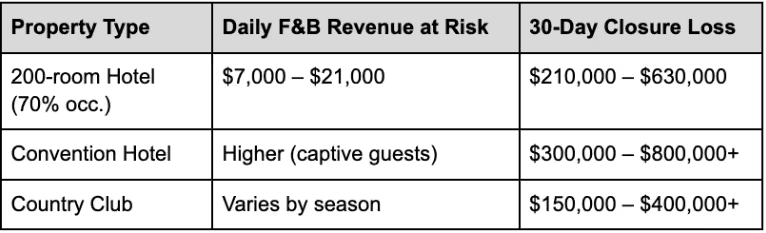
Direct Revenue Loss Analysis by Property Type
Direct revenue loss is the one number you can calculate rather than estimate, and it is worth doing properly before reading further. It turns on three inputs — your average daily F&B revenue, your operating margin, and the real number of dark days including ramp-up. Everything below is what that figure leaves out.

Do not use published averages for this. Daily exposure varies too much by outlet mix, cover count and season for anyone else's benchmark to mean anything against your P&L. Our kitchen downtime cost calculator walks the formula with your own numbers.
Note: Count ramp-up days as dark days. A kitchen that reopens on a Monday is rarely at full output that week.
Labor Force Disruption and Retention Costs
This is the cost that does not end when the kitchen reopens. A brigade cannot sit through a months-long closure unpaid, so you either carry them through non-productive time or you lose them — and losing them is the expensive branch, because the replacement cost lands after the renovation budget has closed.
Cost it as a line, not a position: recruiting, agency fees, onboarding and the weeks a new hire spends below full output, applied to every seat you have to refill. The replacement multiples that circulate in trade coverage do not trace back to primary research, so build the figure from your own recruiting spend instead.
What the number misses is the part your members notice. A rebuilt brigade cooks the same menu differently for months. Recipe consistency, service pace and the unwritten knowledge of how your room actually runs are not on any invoice, and they are the first things a regular remarks on.
Tip: Cost the retain-versus-replace decision before the shutdown, not during it. Once someone resigns you are paying the replacement figure whether you planned for it or not.
Guest Relationship and Brand Recovery Expenses
Guests and members do not pause when your kitchen does — they go somewhere else and find out whether they prefer it. That is the real mechanism behind recovery cost, and it is why the spend to win them back is not symmetrical with the revenue you lost.

Recovery is bought with discounting, marketing and loyalty incentives, all of which run at worse margins than the business they replace. None of it has a standard price, because it depends entirely on how long you were dark and what your competition did with the gap. Which is the argument for not creating the gap.
For a club the exposure is sharper still: dining is a subscribed amenity, so the member is paying either way. Every dark Friday is a bill for something they cannot use.
Project Timeline Extensions and Compounding Financial Impact
Every line above is priced per day, which means a schedule overrun does not add cost so much as multiply it. Kitchen projects overrun for predictable reasons: permitting, long-lead equipment, and an inspection sequence that cannot be compressed without failing it.
The costly response is a rushed reopening. Serving before the fire marshal and health department have both cleared risks a failed inspection, and a re-inspection costs more days than the ones you tried to save. The FDA Food Code is the model most states build on, but your state's adopted edition is what binds you — and the hood and suppression sign-off sits under NFPA 96, on the fire marshal's own schedule rather than the health department's.
Build the schedule from our week-by-week renovation timeline rather than from a contractor's best case.
Comprehensive Kitchen Shutdown Cost Mitigation Strategies
Every cost here shares one driver: the number of days without service. Reduce that and all of them fall together. There are only three real levers for doing so, and they are not equally available once a date has been fixed with your contractor.

| Lever | Removes | Constraint |
|---|---|---|
| Phase the work | Some dark days | Slower build, higher total cost |
| Renovate off-season | Guest and member exposure | Only if the calendar allows |
| Temporary kitchen | Nearly all dark days | Needs 2–3 months' lead time |
Phasing and off-season scheduling are covered in our phased versus full shutdown comparison. The third option is the one that removes the variable entirely, and it is the one that needs deciding earliest.
Financial Impact Calculation Framework
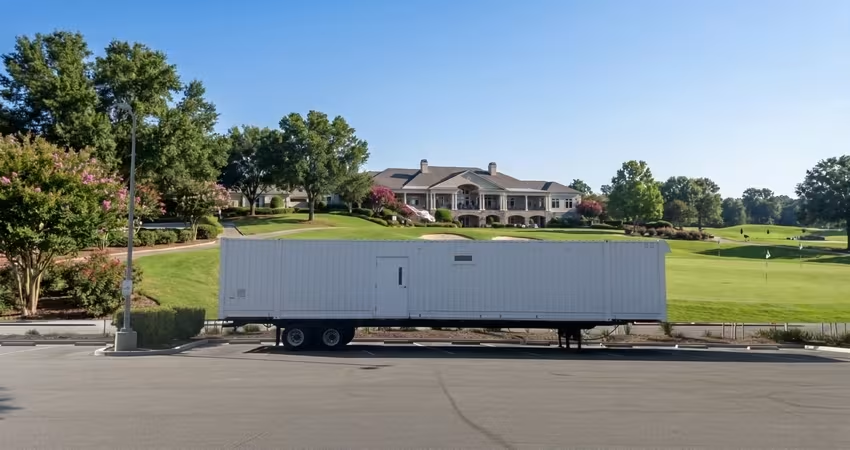
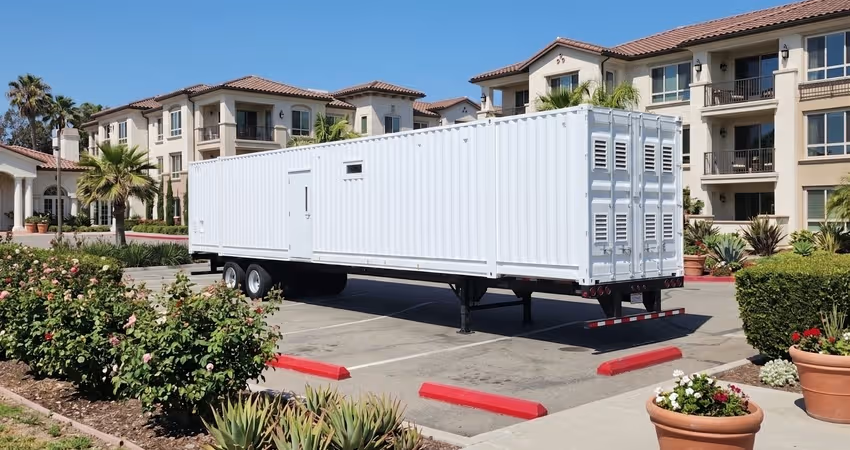
Mobile Culinaire builds from manufactured kitchen modules in-house in Oregon rather than converting trailers, with more than 400 units delivered across the United States in four footprints from 32 to 2×53 feet. Deployments span hotels, private clubs, senior living and municipal programmes. Discovery and design run two to four weeks each, permitting one to six, delivery and installation about a week.
That sequence is the reason to decide early. A temporary kitchen cannot be sourced in the week the schedule slips — the decision has to sit alongside the construction budget, not behind it. Talk to us before your dates are fixed.
Conclusion
Kitchen shutdown costs are usually presented as lost revenue, which is the one line that stops when the kitchen reopens. Staffing, guest attrition and a rushed reopening all outlast the project, and none of them appear in a construction budget.
Calculate the revenue exposure properly, price the retain-versus-replace decision before you need it, and treat continuity as a line item rather than a contingency. See what we rent.
Disclaimer
Cost figures cited here come from named third-party sources and describe general market conditions, not Mobile Culinaire pricing or any predicted outcome for your operation. Permit, health and fire requirements vary by state, county and municipality. Model your own exposure and confirm every requirement with your authority having jurisdiction.
People Also Ask
Three questions come up whenever a shutdown budget goes to a board for approval. Two of them ask for a figure, and the honest answer in both cases is that the number is yours to calculate against your own P&L rather than ours to publish.
How much revenue does a kitchen shutdown cost?
There is no useful average. Exposure is your average daily F&B revenue multiplied by your operating margin and the total number of dark days, including ramp-up. Outlet mix, season and cover count vary too much between properties for a published benchmark to be worth applying. Run the figure against your own P&L.
What are the hidden costs of a kitchen shutdown?
The ones that outlast the renovation: replacing kitchen staff who could not wait out the closure, discounting and marketing to recover guests who found an alternative, and the re-inspection risk of reopening before both the health department and fire marshal have cleared. None appear in a construction budget.
Can a property stay open during a kitchen renovation?
Yes, by phasing the work, scheduling around the off-season, or running a temporary kitchen through the window. Only the third removes dark days almost entirely, and it needs the longest lead time — two to three months from first conversation to first service, so it has to be decided alongside the construction budget.


Testimonial

"What is standing out when you look at the mobile kitchen operation is the efficiency that we can really achieve because it's built for that."
Tell us about your kitchen needs and request a quote.
.png)
Turnkey mobile kitchen
Proudly made in-house in the USA
Commercial grade kitchen equipment
Code-compliant
Trusted by Industry Leaders