.gif)
When a hotel, resort, or country club signs off on a temporary kitchen for a renovation, the grease trap is rarely the headline. Yet it is one of the few components that can quietly fail an opening inspection. An undersized — or missing — mobile kitchen grease trap sends fats, oils, and grease straight into the property's sewer line, and that is exactly what health and plumbing inspectors look for. For a full-service operation running four to eight months, getting the grease interceptor right is not a detail. It is a precondition for service. This guide walks through how to size, choose, install, and maintain the right unit for a trailer-based commercial kitchen.
Why a Mobile Kitchen Trailer Still Needs a Grease Trap
A mobile kitchen grease trap separates fats, oils, and grease — collectively known as FOG — from kitchen wastewater before it enters the sewer. Warm FOG pours freely down a drain, then cools, hardens, and coats the inside of pipes until flow stops entirely. The downstream cost is significant: according to the U.S. Environmental Protection Agency, grease from restaurants and other sources is the most common cause of reported sanitary sewer blockages, implicated in roughly 47% of cases. University extension research, including this Clemson FOG pollution factsheet, reaches the same conclusion.
Temporary status does not change the math. A mobile kitchen producing the same number of covers as a permanent one generates the same FOG load — and most jurisdictions regulate the two identically.
What a grease trap actually does
- Slows incoming wastewater so FOG can separate by density
- Allows grease to float to the top and food solids to settle at the bottom
- Releases cleaner water from the middle layer to the sewer
- Holds captured FOG and solids until they are pumped out
Note: A grease trap is not a treatment device. It captures and holds FOG so it can be removed later. If it is never serviced, it stops working — and discharge violations follow.
The trailer difference: space, access, and permits
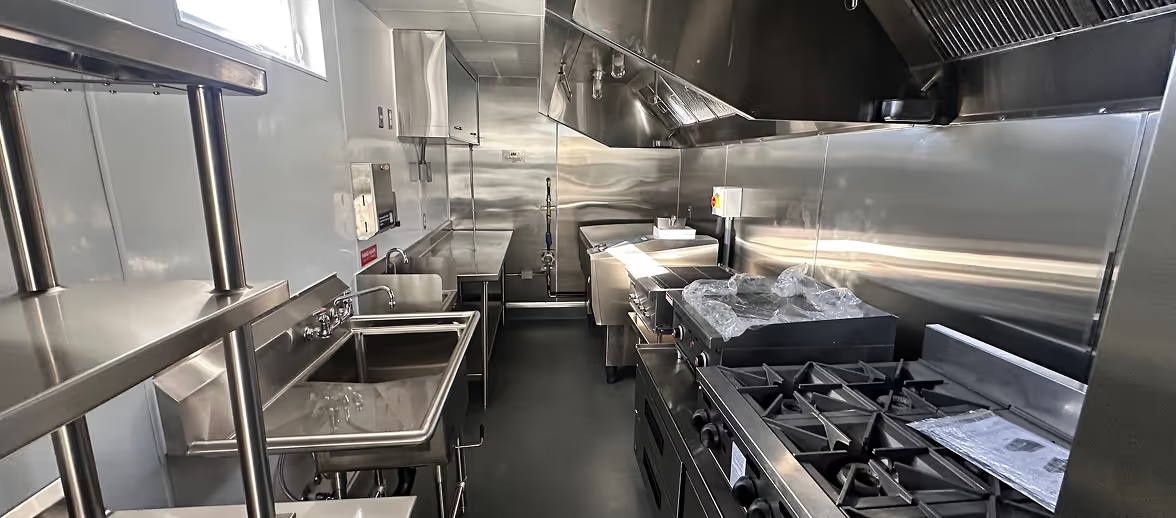
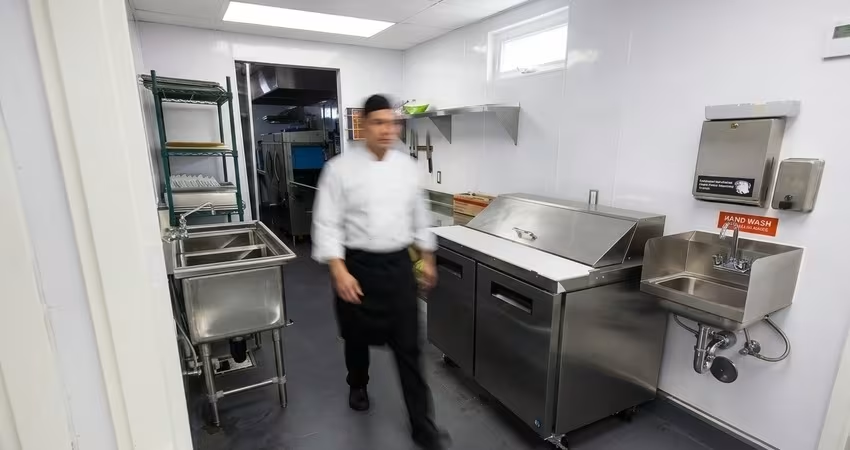
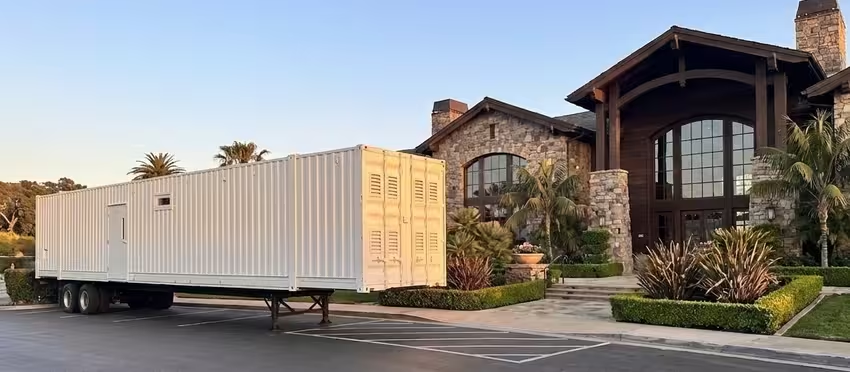
The complication unique to a mobile kitchen grease trap is real estate. A permanent kitchen can bury a large in-ground interceptor in the parking lot. A trailer cannot. Every plumbing run, every fixture, and every interceptor has to fit within the unit's footprint or sit immediately beside it, all while remaining accessible for a pump truck.
That constraint shapes three decisions: the type of interceptor, where it is placed, and how it is serviced. Purpose-built units handle this by design — Mobile Culinaire's mobile kitchen trailers are manufactured with standardized plumbing and pre-planned grease management, rather than the improvised drain routing common in retrofitted trailers. For a fuller view of what ships with a unit, see the kitchen trailer equipment guide.
Grease Trap vs. Grease Interceptor: Types That Fit a Mobile Unit
The terms "grease trap" and "grease interceptor" are often used interchangeably, though "interceptor" usually implies a larger-capacity unit. What matters more is the category of device, because each behaves differently in a space-limited trailer. Choosing the right category is the first real decision in specifying a mobile kitchen grease trap.
Hydromechanical grease interceptors (HGIs)
These are the compact, under-sink or near-sink units most associated with mobile kitchens. They use baffles and flow control to separate FOG quickly in a small volume. They install indoors, carry a low upfront cost, and suit the tight quarters of a trailer — but their smaller capacity means more frequent cleaning.
Gravity grease interceptors (GGIs)
Large concrete or polyethylene tanks, typically 500 to 2,000+ gallons, installed below grade. They offer enormous capacity and long service intervals, which is why permanent kitchens favor them. For a temporary deployment, an in-ground GGI is usually impractical: it requires excavation, permitting, and restoration that rarely make sense for a unit on site for a few months.
Automatic grease removal devices (AGRUs)
A motorized evolution of the HGI. AGRUs skim accumulated grease automatically into a separate collection bin, reducing pump-out frequency and labor. They cost more upfront and draw power, but their compact, low-maintenance design fits mobile operations well — staff can empty the bin without scheduling a hauler for every service.
The table below summarizes the trade-offs for a trailer-based kitchen.
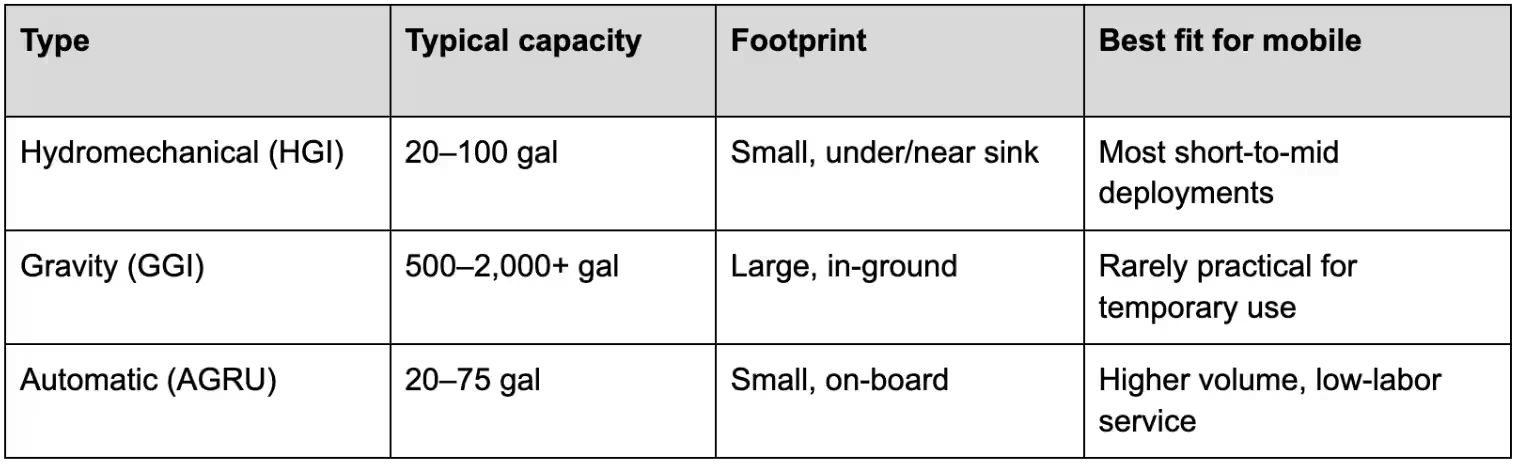
Tip: Match the device to deployment length, not just menu volume. A six-month renovation often justifies an AGRU's higher cost through lower service labor over time.
How to Size a Grease Trap for a Mobile Kitchen
Sizing is a calculation, not a guess. The goal is to give wastewater enough time inside the unit for FOG to separate before water exits to the sewer.
The flow-rate and retention-time formula
The core method multiplies total fixture flow rate, measured in gallons per minute (GPM), by a required retention time. Each fixture draining into the trap contributes flow: a three-compartment sink runs roughly 30–45 GPM, a prep sink around 15 GPM, and a dishwasher anywhere from 5 to 40 GPM depending on the model.
When multiple fixtures feed one trap, they rarely all drain at once. The WebstaurantStore grease trap sizing guide describes the standard approach: take 100% of the largest fixture's flow rate, 50% of the second largest, and 25% of each remaining fixture, then size against that total.
Worked example:
- Three-compartment sink: 30 GPM (100%) = 30
- Dishwasher: 15 GPM (50%) = 7.5
- Prep sink: 15 GPM (25%) = 3.75
- Total design flow ≈ 41 GPM
At a two-minute retention standard, that points to an interceptor near 82 gallons — before adding a buffer.
The 25% solids buffer and code minimums
Solids settle and reduce a trap's working volume, so industry practice adds 20–25% to the calculated size. Beyond that, local codes often set hard minimums that override the formula. Jurisdictions vary widely, which is why the same kitchen can need different units in different cities.
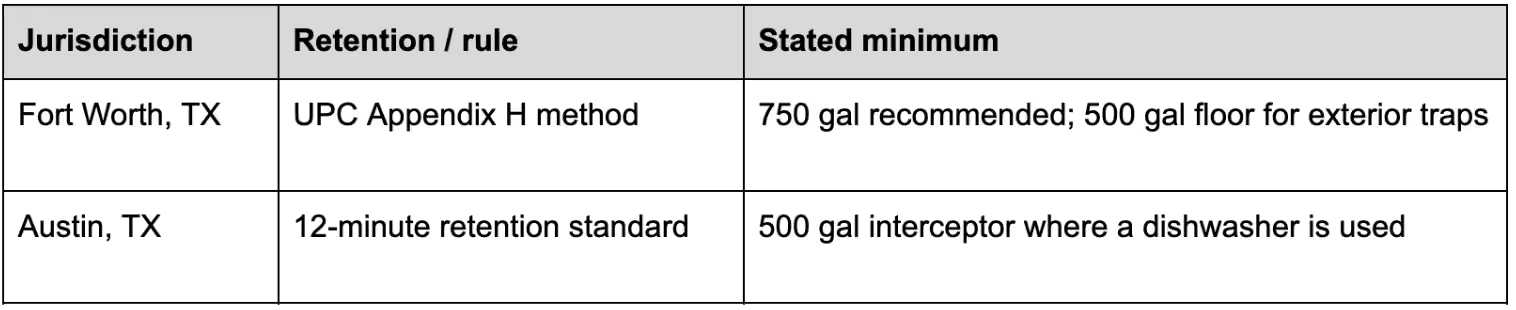
You can review the underlying criteria directly from the utilities: Fort Worth Water's grease-trap guidance and Austin Water's grease trap sizing and design criteria. Note that Austin has prohibited garbage disposals in commercial kitchens since 2008 — a reminder that local rules reach beyond sizing alone.
Code references that govern sizing
Most jurisdictions adopt one of two model codes. The Uniform Plumbing Code, Chapter 10 and Appendix H, provides the flow-based sizing method used by Fort Worth and many western states, while the International Plumbing Code governs interceptors elsewhere. Both lean on the Plumbing & Drainage Institute's PDI-G101 standard for hydromechanical units. The practical takeaway: confirm which code your deployment site follows before sizing anything.
Installation and Placement on a Trailer
Where the interceptor sits is as regulated as how big it is. Placement of a mobile kitchen grease trap has to be engineered in advance, because a trailer leaves no room to improvise. Fort Worth, for example, requires traps to be installed a minimum of 10 feet from sinks and dishwashers and built with at least two baffles.
- On-board mounting: HGIs and AGRUs typically mount inside the unit or in a service bay, keeping pipe runs short.
- External placement: Higher-volume operations may set an interceptor immediately outside the trailer, which eases pump-truck access.
- Service access: Whatever the location, leave clearance for lid removal and pumping. A unit you cannot reach is a unit you will not maintain.
Permitting ties directly to this. Health and plumbing departments verify grease management as part of the temporary food-service approval, a process detailed in the mobile kitchen trailer permits guide. Factoring the interceptor into the plan early also keeps budget predictable; grease traps typically add a modest line item, as outlined in the mobile kitchen rental cost breakdown.
Grease Trap Maintenance and FOG Compliance
A correctly sized mobile kitchen grease trap only works if it is emptied on schedule. This is where many temporary operations stumble.
The 25% rule and service cadence
The widely used industry benchmark — sometimes called the "25% rule" or "¼ rule" — says a grease trap should be cleaned once accumulated FOG and solids reach 25% of the unit's total liquid depth. Past that point, separation efficiency drops and grease begins escaping to the sewer. For a busy hospitality kitchen, a smaller HGI may hit that threshold within weeks, while a larger interceptor stretches the interval. As a general baseline, mobile units are commonly serviced every one to three months depending on volume.
Manifests, haulers, and avoiding violations
- Use a licensed hauler. FOG must be pumped and disposed of by a permitted liquid-waste contractor.
- Keep manifests. Each pump-out should generate documentation. Inspectors ask for service records, and missing paperwork can read as non-compliance.
- Schedule before deployment. Build hauler service into the project timeline so the first cleaning is booked before the trap ever fills.
Choosing the right interceptor up front makes all of this easier. For broader guidance on matching equipment to a deployment, see how to choose the perfect mobile kitchen.
Get the Grease Trap Spec Right Before You Deploy
A mobile kitchen grease trap is small, but it carries outsized risk: an inspection failure, a sewer backup, or a discharge violation can halt service in a kitchen you are paying to keep running. The fix is straightforward — size it to your fixtures and local code, choose a type that fits a trailer, place it for access, and service it on the 25% rule.
If you are scoping a temporary kitchen and want the interceptor sized and specified correctly for your site and jurisdiction, talk to a Mobile Culinaire project coordinator. We engineer grease management into every unit so compliance is handled before the trailer arrives — not discovered at inspection.
People Also Ask (FAQ)
Does a mobile kitchen need a grease trap?
In almost all cases, yes. Any mobile kitchen that discharges wastewater to a municipal sewer must pretreat FOG, just like a permanent kitchen. The main exception is a unit that hauls all wastewater off-site to an approved disposal facility, which some jurisdictions allow for short-term events. For a mid-to-long-term hospitality deployment connected to a property's sewer, a properly sized grease trap is effectively mandatory — and a frequent inspection checkpoint.
What size grease trap do I need for a mobile kitchen?
It depends on your connected fixtures and your local code, not your seat count. Calculate total design flow (100% of the largest fixture, 50% of the second, 25% of the rest), multiply by your jurisdiction's retention time, then add a 20–25% solids buffer. Many cities also impose minimums — 500 to 750 gallons is common where a commercial dishwasher is present — so always confirm with the local water utility before specifying a unit.
How often should a mobile kitchen grease trap be cleaned?
Follow the 25% rule: clean the trap when FOG and solids reach a quarter of its liquid depth. In practice, that translates to roughly every one to three months for most mobile kitchens, though a high-volume operation with a compact HGI may need service every few weeks. Track accumulation rather than relying on the calendar alone, keep a manifest for every pump-out, and adjust the interval based on what you actually find.

%20(1).avif)
Testimonial

"What is standing out when you look at the mobile kitchen operation is the efficiency that we can really achieve because it's built for that."
Tell us about your kitchen needs and request a quote.
.png)
Turnkey mobile kitchen
Proudly made in-house in the USA
Commercial grade kitchen equipment
Code-compliant
Trusted by Industry Leaders