.gif)
Could you name the amperage rating of the panel powering your rental trailer kitchen? How many of its branch breakers are GFCI-protected? Where the working clearance starts and ends?
For most hospitality operators, the answers move quickly from "roughly" to "no idea." That is understandable — chefs evaluate gear, not switchgear — but the food trailer electrical panel is the single component that decides whether dinner service runs or stops. A miscalculated food trailer electrical panel nuisance-trips during peak ticket flow. A non-compliant one fails inspection a day before opening. This guide breaks down how a food trailer electrical panel is sized, what is inside it, where code says it must sit, and what to verify before signing a rental.
What an Electrical Distribution Panel Does in a Food Trailer
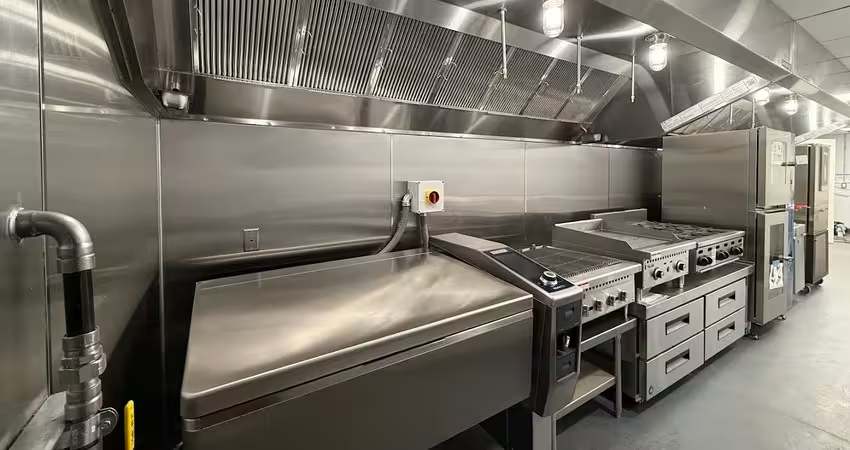
A food trailer electrical panel is the centralized hub where the trailer's incoming service is split into individual branch circuits. Everything downstream — combi ovens, walk-ins, hood exhaust, lighting, receptacles — pulls power through the mobile kitchen electrical panel.
In a purpose-built mobile kitchen trailer, the panel is engineered alongside the equipment package: load calculations, breaker layout, and enclosure rating are decided before fabrication. In a retrofitted trailer, the panel is often a residential-grade leftover bolted in after the fact, which is exactly where most rental failures originate.
A food trailer electrical panel is not "the breaker box." It is the part of the broader electrical service that turns shore power or generator output into safe, code-compliant branch distribution.
Service Type and Panel Capacity
Before sizing the food trailer electrical panel itself, the incoming service has to be defined. Two factors drive panel selection: phase configuration and total amperage.
Single-Phase 240V vs. Three-Phase 208V Service
- Single-phase 240V is common in smaller trailers serving banquet, pop-up, or limited-menu programs. It handles standard cooking equipment and refrigeration but tops out before heavy three-phase loads.
- Three-phase 208V (or 480V in some industrial sites) is standard for full-service kitchens running combi ovens, conveyor toasters, induction ranges, and walk-in compressors simultaneously. Three-phase delivers more usable power per ampere and balances loads across legs more efficiently.
Phase selection is not optional once equipment is specified. A three-phase combi oven cannot run on single-phase service, full stop.
Common Amperage Ratings
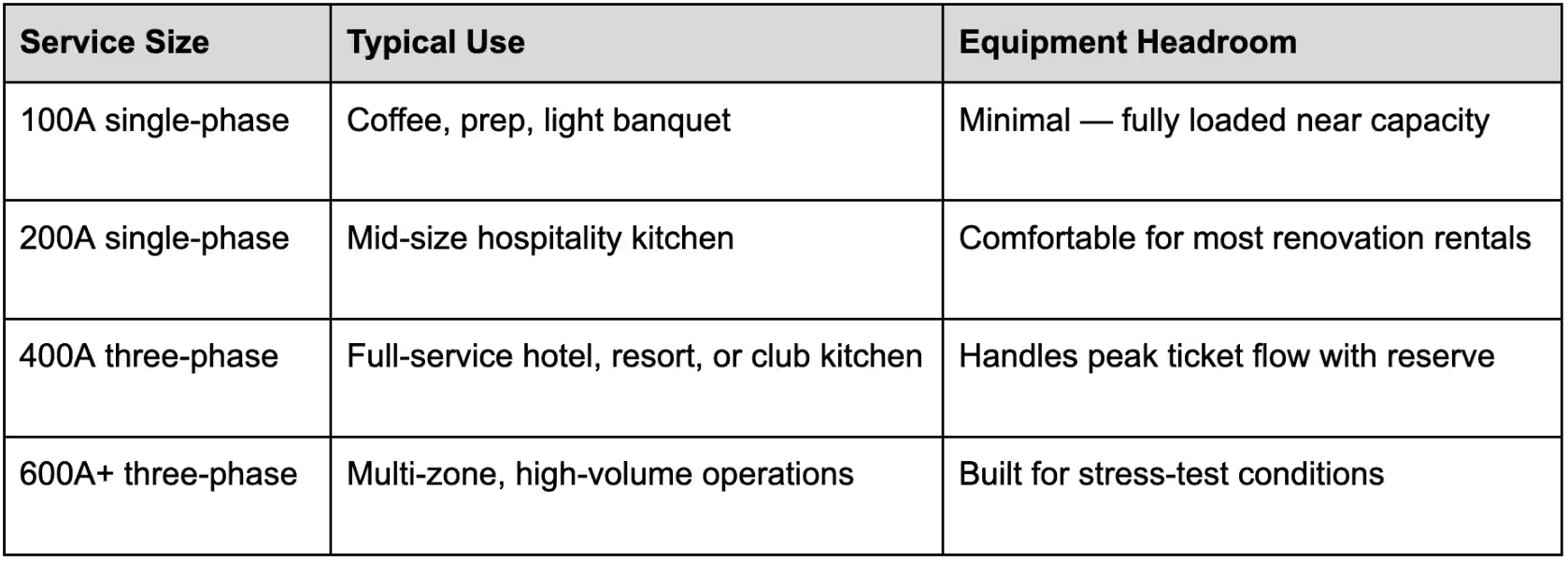
Underspeccing the service is the most common rental mistake. Operators size to "what we usually use" rather than running an actual load calculation against the equipment package being deployed.
Load Calculation Fundamentals (NEC Article 220)
The National Electrical Code (NFPA 70), specifically Article 220, defines the method for calculating loads. Every commercial mobile kitchen electrical panel should be sized using this framework, not by eyeballing nameplate ratings.
Connected Load vs. Demand Load
- Connected load is the sum of every nameplate rating on the trailer. Combined, this number is intentionally larger than what the panel will actually carry.
- Demand load applies NEC's demand factors, which acknowledge that not all equipment runs at peak simultaneously. A combi oven's compressor cycles. A hood fan runs continuously but at a known draw. Demand calculations produce the realistic figure the panel must handle.
Note: A 400A service does not mean "400 amps of equipment can be plugged in." After applying NEC demand factors and a continuous-load safety buffer (typically 20–25%), usable continuous capacity is closer to 300–320A.
Sample Load Profile
A 40-foot mobile kitchen running a hotel breakfast and dinner service might pull approximately:
- Combi oven (three-phase): 60A
- Walk-in refrigeration: 30A
- Walk-in freezer: 35A
- Hood exhaust + makeup air: 25A
- Lighting, receptacles, HVAC: 50A
- Reserve buffer (20%): 40A
That puts the trailer at roughly 240A continuous on three-phase service — well within a 400A panel.
Inside the Panel: Components Operators Should Recognize
A walkthrough of the food trailer electrical panel before delivery acceptance catches more problems than any spec sheet.
Main Breaker and Service Disconnect
The main breaker is the single shutoff for the entire panel and acts as the service disconnect. It must be clearly labeled and accessible. NEC requires the disconnect to be operable without removing the panel cover — a detail retrofitted installations regularly miss.
Branch Circuit Breakers
Branch breakers split the main feed into protected circuits. Three types appear in a mobile kitchen:
- Standard thermal-magnetic breakers for fixed equipment circuits
- GFCI (Ground-Fault Circuit-Interrupter) breakers for receptacles near water, required by NEC 210.8 in commercial kitchens
- AFCI (Arc-Fault Circuit-Interrupter) breakers where specified for areas with combustible insulation or sleeping quarters
Bonding, Grounding, and Neutral Bars
NEC Article 250 governs grounding and bonding. In a trailer, the chassis must be bonded to the panel's grounding bus, and a separate grounding electrode connection is required when shore power is used. Improper bonding is one of the most common failed-inspection items on retrofitted units.
NEMA Enclosure Ratings for Trailer Environments
The panel's enclosure rating defines what environment it can survive. NEMA enclosure standards classify ratings as follows:
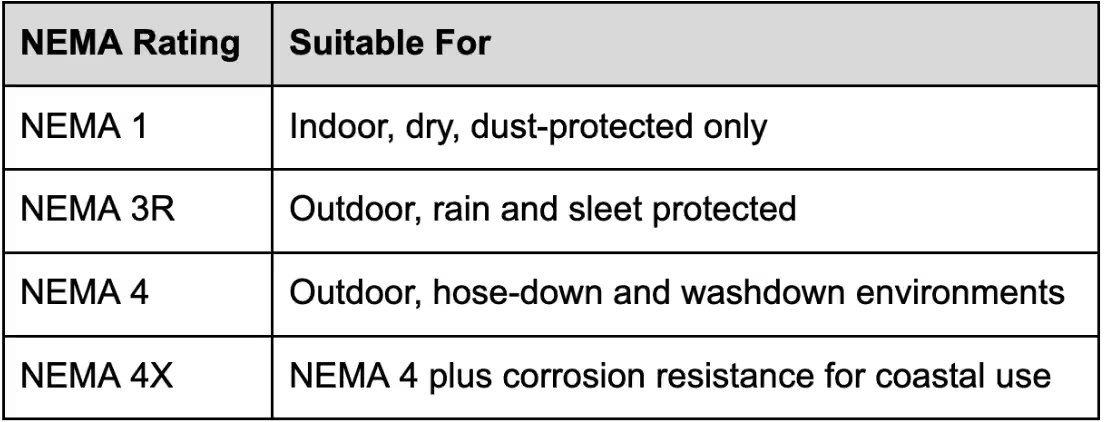
A panel mounted on a trailer exterior should be at minimum NEMA 3R, with NEMA 4 or 4X preferable for coastal or washdown deployments. Panels must also be UL 67 listed — the safety standard for panelboards.
Panel Placement and Working Clearances
A correctly sized food trailer electrical panel can still fail inspection if it is placed wrong.
NEC 110.26 Workspace Requirements
NEC 110.26 defines the working space that must remain clear in front of any electrical equipment likely to require examination, adjustment, or maintenance while energized:
- Depth: minimum 3 feet in front of the panel (more if voltage exceeds 150V to ground)
- Width: 30 inches or the panel width, whichever is greater
- Height: 6.5 feet of clear headroom
Nothing can be stored in this clearance zone — not a prep table, not a stack of bus tubs, not a rolling cart parked "just for service." Inspectors photograph these zones.
Indoor vs. Exterior Mounting Trade-offs
Tip: When the panel sits on an exterior wall, request a weatherproof access cover and confirm the working clearance still applies. The 3-foot zone extends outward from the panel face, even outside the trailer envelope.
Exterior panels simplify utility connection and inspection access but require higher enclosure ratings. Interior panels are easier to operate during inclement weather but consume floor space inside the trailer.
Labeling, Documentation, and What Inspectors Verify
Every breaker must be identified — not "Outlets" but specifically "Outlets, prep counter east wall." NEC 408.4 requires accurate, durable directories, and NEC 110.21 and 110.22 cover required field markings for manufacturer identification and disconnect labeling.
What inspectors verify at commissioning:
- Panel directory complete and legible
- Main disconnect labeled with available fault current
- Grounding electrode connection visible and torqued
- GFCI and AFCI breakers test correctly
- Working clearances clear and dimensioned
- NEMA enclosure rating matches the mounting environment
- Panel is UL 67 listed (verifiable by label)
Documentation handed off at delivery should include the load calculation worksheet, breaker schedule, and panel datasheet. If the rental provider cannot produce these, the panel has not been engineered — it has been improvised. This verification belongs on every commissioning checklist.
Common Food Trailer Electrical Panel Failure Modes
These are the recurring issues that surface in mobile kitchens during deployment:
- Overloaded circuits during peak service
Too many high-draw appliances on a single branch. Diagnosed by reviewing the breaker schedule against actual equipment layout.
- Nuisance tripping vs. genuine fault tripping
Frequent trips on one breaker usually mean an undersized conductor or shared neutral — not a "bad breaker." Replacing the breaker without diagnosing the cause is a recurring rental complaint.
- Vibration and corrosion damage
Trailers move. Panels not designed for road vibration develop loose terminations, which create heat, which create arc events. OSHA 29 CFR 1910.303 covers maintenance requirements for energized electrical equipment.
- Weatherproofing failures
Sealant gaps around exterior conduit entries let moisture into the enclosure. Often invisible until the first hard rain.
Proper trailer leveling and setup directly affects panel reliability — an unlevel chassis stresses conduit connections and accelerates corrosion at termination points.
How Purpose-Built Panels Solve Rental Reliability
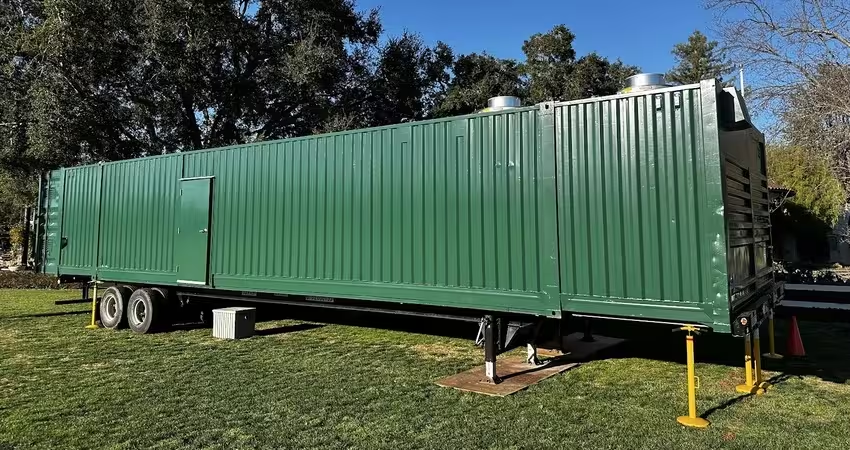
Mobile Culinaire engineers each food trailer electrical panel as part of the kitchen module, not as an aftermarket addition. Load calculations are run against the actual equipment package. Enclosures meet NEMA 4 for exterior trailer service. Breaker directories are populated and labeled at the factory. Documentation — load worksheet, breaker schedule, NEC compliance summary — is delivered with the unit.
This matters because rental decisions are usually made by operators, not electricians. A panel engineered to spec from the start removes the inspection risk and the mid-service failure risk that retrofit panels carry.
Plan Your Mobile Kitchen Power with Mobile Culinaire
Sizing a food trailer electrical panel correctly is a one-time decision that affects every service that follows. Mobile Culinaire's hospitality team runs the load calculation, specifies the panel and service to match, and delivers complete documentation with each purpose-built mobile kitchen. See deployed projects for examples, or request a consultation to walk through your equipment list and site conditions.
Disclaimer
This article is for informational purposes only. Electrical service sizing, panel selection, and installation must be performed by a licensed electrician in accordance with the National Electrical Code, applicable building codes, and the requirements of the local authority having jurisdiction.

People Also Ask (FAQ)
How many amps does a food trailer electrical panel need?
It depends on equipment load, but a typical mid-size hospitality mobile kitchen needs 200–400A of service. Light-duty trailers manage on 100A; full-service hotel kitchens with three-phase combi ovens and dual walk-ins often need 400A or more. The only reliable answer comes from running an NEC Article 220 load calculation against the actual equipment list.
Can a food trailer plug into a standard outlet?
No. A standard 120V/15A or 20A outlet cannot support commercial cooking equipment. Mobile kitchens require dedicated service — typically 240V single-phase or 208V three-phase — delivered through a properly sized panel via shore power or a permitted generator setup.
What is the difference between single-phase and three-phase service for a food trailer?
Single-phase 240V delivers power on two hot conductors and works for smaller kitchens. Three-phase 208V or 480V delivers power on three conductors, runs heavy equipment more efficiently, and is required for most full-service kitchen equipment lines. Phase requirements come from the equipment, not the operator's preference.
Where should the electrical panel be located in a mobile kitchen?
Per NEC 110.26, the panel must have 3 feet of clear depth in front, 30 inches of width, and 6.5 feet of height — and that zone must stay permanently clear. Most trailers mount the panel on an exterior wall (NEMA 3R or 4 enclosure) for utility access, though interior mounting is acceptable when clearances are maintained.

Testimonial

"What is standing out when you look at the mobile kitchen operation is the efficiency that we can really achieve because it's built for that."
Tell us about your kitchen needs and request a quote.
.png)
Turnkey mobile kitchen
Proudly made in-house in the USA
Commercial grade kitchen equipment
Code-compliant
Trusted by Industry Leaders